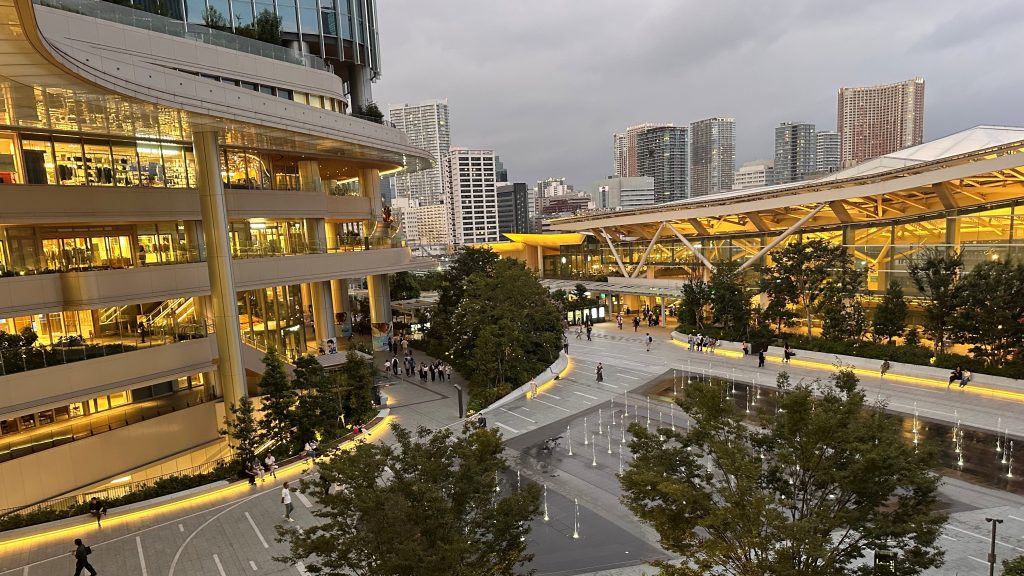
It’s mind-boggling, overwhelming and fascinating all at once.
There are offices, hotels, shops, supermarkets, restaurants, theatres and museums. Add parks, gardens, public plazas and art installations.
You can get around on autonomous robotic carts.
It’s easy to get lost among the buildings and public spaces. And you can spend an entire day here without really noticing just how much has been designed to keep everything connected and convenient.
On my first visit, it took me a while to take it all in. Coming from the United States or Europe, it feels like stepping into the future.
This is Takanawa Gateway City, Tokyo’s newest urban mega-development, which opened in March 2026.
Other big cities around the world build a new stadium, a flagship mega mall or a new office tower.
Tokyo simply builds an entire new city within the city. Takanawa Gateway City is expected to cater for a daytime population of about 100,000 people!
And it’s not the only mega complex in Tokyo. Places like Azabudai Hills, Toranomon Hills or Tokyo Midtown are all designed to pack an entire neighborhood into one footprint.
Are these posh luxury projects? Mostly, yes.
Are they genuinely mixed communities? Time will tell.
But they are indicative of how Tokyo wants to grow. How the city handles land, transit, and redevelopment. Instead of building outwards, developers buy land parcels over time and replace older buildings with these large super-blocks.
Often built directly on top or next to a major station, it’s easy for people to commute to and from these places.
And the appeal is obvious: you can work, live, shop, go out and relax – all in one place.
Then there’s safety. Modern mega complexes are easier to equip with earthquake-resistant engineering, backup power, water systems and evacuation plans. All very important in a place like Japan where earthquakes are a regular occurrence.
To me, Tokyo’s mega complexes are more than impressive construction projects.
They may not be the future of urban living in every country.
But they offer a glimpse into how one of the world’s largest cities is preparing for the future.
Did you know:
- Japan encourages redevelopment through relaxed zoning for large projects, tax incentives for rebuilding old areas and by allowing mixed-use towers.
- The planning and conceptualization of Takanawa Gateway City took about 20 years, the construction 5-6 years.
- Takanawa Gateway City is being built on land once occupied by railway facilities. The redevelopment is transforming a former rail yard into a new mixed-use urban district. A great example of how Tokyo is turning underused transport land into a new part of the city.
Read more Japan Nuggets: https://japannuggets.com/


Leave a Reply