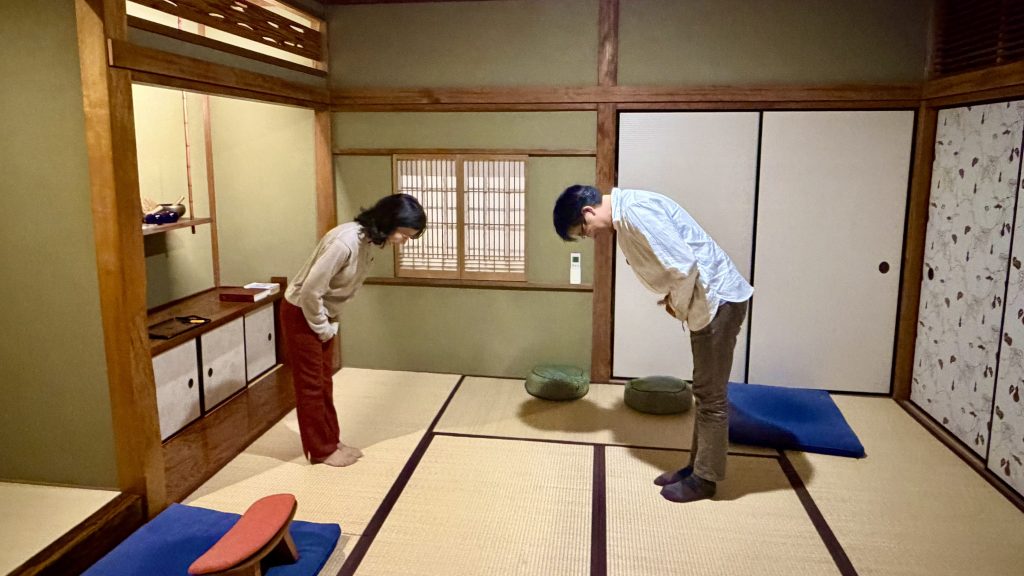
I was stuck in a bowing loop.
I had just left an excellent restaurant, and the owner bowed us farewell at the door. I bowed back. He replied by bowing a little deeper. I did the same. Several repeats followed. The elevator door had long closed. At some point I retreated backward into the elevator and left. Phew.
This is not an uncommon experience in Japan. People bow – a lot.
To greet you. To thank you. To apologize. To say goodbye.
You bow when introducing yourself. Or when asking for a favor.
But why do it?
Bowing (ojigi) isn’t just a habit. It’s a social language.
It shows respect in a culture where harmony, hierarchy, and social norms matter a great deal. Influenced by Buddhist traditions and samurai etiquette, bowing evolved over centuries and gradually spread through society.
In the United States and Europe, we prefer words, handshakes, embraces and hugs. In Japan, physical contact between people who aren’t family or close friends is less common. Bowing is a polite way to acknowledge others.
Even the depths and lengths of bows have meaning. Traditionally, age, job position, and social roles all matter in Japan. A deeper bow shows greater respect.
And actions matter as much as words. So, saying sorry or thank you is usually paired with a bow.
In many workplaces, bowing is part of the job, especially in hospitality, retail, and corporate settings. You leave a restaurant, hair salon or shop and staff will bow to thank you for coming. Even in my supermarket, the cashiers give me s small bow after I’ve paid.
But people don’t bow constantly. They bow at meaningful moments. Greeting, entering a room, thanking, apologizing, or closing an interaction.
Should tourists bow? Absolutely. But don’t worry about perfection. A small, sincere bow is always appreciated. What matters is the intention. Just follow the other person’s lead.
So when you find yourself trapped in a Japanese bowing loop, don’t panic. Smile, give a small bow, and take the elevator.
Did you know:
- People bow on the phone. Many Japanese instinctively bow while speaking on the phone, even though the other person can’t see them. It’s like second nature.
- In business, employees are often taught specific bow angles: around 15° (Eshaku) for greetings. 30° (Keirei) for customers and formal introductions, and 45° (Saikeirei) for deep apologies or showing great respect.
- Dogeza is a Japanese gesture of extreme apology or submission. It involves kneeling and bowing deeply with your forehead near the ground. While it’s common in anime and some films, it’s very unusual in everyday life today.
Read more Japan Nuggets: https://japannuggets.com/


Leave a comment