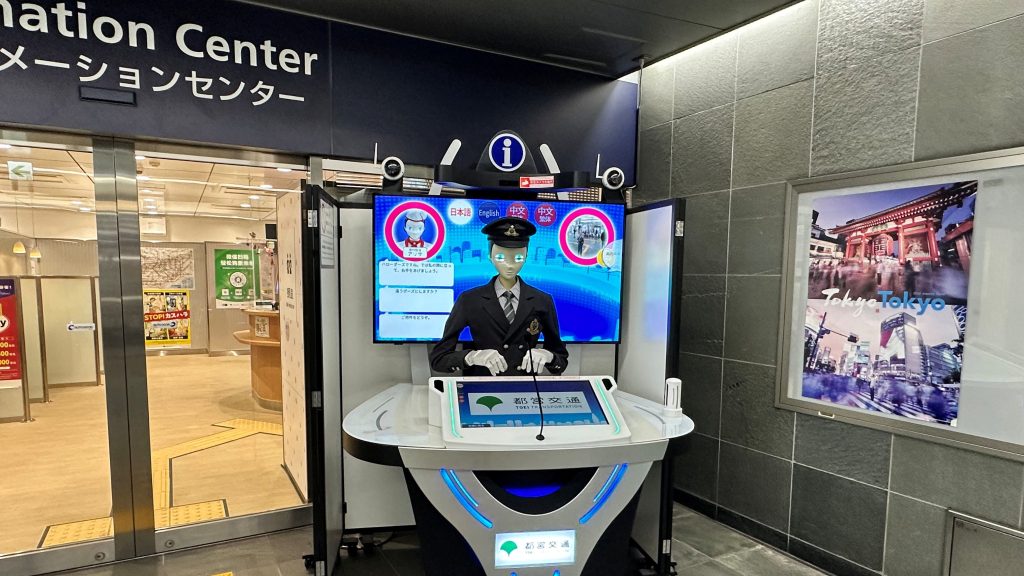
Robots deliver your meal in a restaurant or collect dirty dishes. Others clean the lobbies of office buildings. AI robot concierges in train stations help you find a route or the next toilet.
Smart toilets change the way you do your business. Even my stove at home talks to me.
It can feel as if you’ve stepped into the future. And yes, this is everyday technology in Japan.
Add top notch engineering like the famous Shinkansen bullet trains which run with remarkable speed, safety, and punctuality.
Convenience stores also use technology in everyday life. Beyond buying snacks, you can pay utility bills, collect online orders, print official documents, or purchase concert tickets – all in one place.
Service robots are present in many places, especially in big cities. Movies, social media and travel guides love reinforcing this image of Japan.
Yet, it’s only half of the story.
Japanese bureaucracy in particular can be surprisingly analogue.
Opening a bank account, registering your address, or completing government paperwork often involves multiple forms, in-person visits and even official stamps (hanko). Paper documents are common. Cash remains widely accepted.
When I first visited a government website, I thought I had stepped back into the early 2000s. Don’t expect sleek apps and one-click forms. Rather crowded pages with lots and lots of text.
Joining a gym or seeing a doctor means completing more paper forms.
Yes, it’s surprising. And yet, it’s very much Japan.
Part of the answer is Japan’s approach to innovation. New technology is often adopted when it solves a specific problem, not simply because it’s new.
At the same time, government agencies and large organizations tend to move cautiously. This can slow digital transformation.
The result is a fascinating blend of old and new. It’s perfectly normal to travel on one of the world’s most advanced trains in the morning, order your meal from a touchscreen and be served by a robot, then discover the restaurant only accepts cash.
Japan isn’t simply high-tech or old-fashioned – it’s both. What’s surprising to many visitors makes everyday life here so fascinating.
Did you know:
- Japan uses technology heavily for disaster preparedness. Sensors, simulations and communication systems help prepare for earthquakes, tsunamis, typhoons and volcanic eruptions.
- Much of Japan’s most important technology is behind the scenes. Precise manufacturing, sensors, robotics, power electronics and specialized components are used around the world.
- Japan has invested heavily in technology for its ageing population. Robots and automated systems are being developed for care, mobility assistance, monitoring and other areas facing labor shortages.
Read more Japan Nuggets: https://japannuggets.com/


Leave a Reply