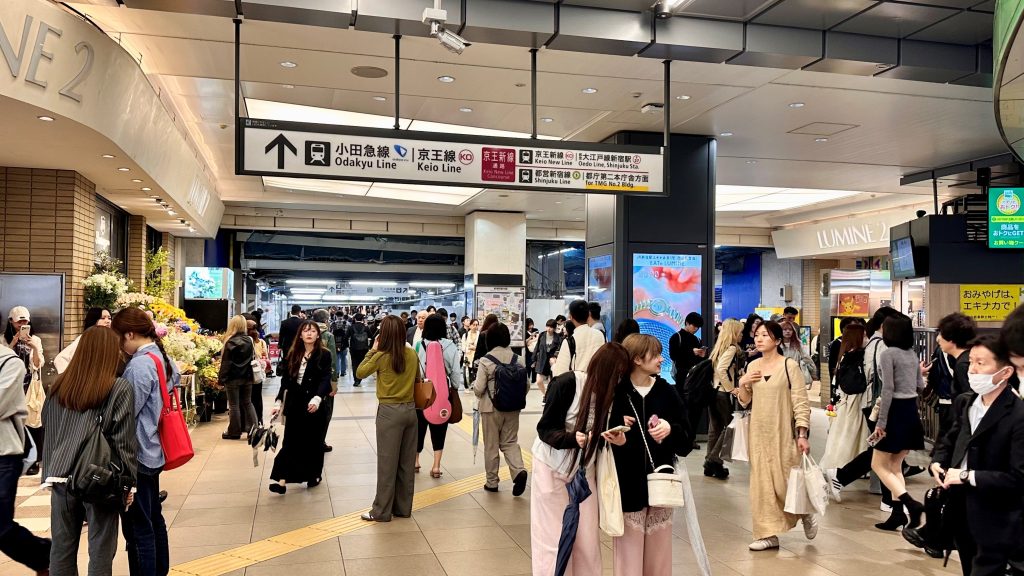
Raise your hand if you’ve been to Tokyo and gotten lost in Shinjuku Station. Mine is up – multiple times.
Shinjuku Station isn’t just large. It operates on a scale most cities never reach. Tourists panic, first-timers slow down, locals move through it with years of training.
Tokyoites say: You don’t find your way in Shinjuku, you learn your exit.
Shinjuku station is the busiest in the world – and it’s more than just a station. It’s a cluster of interconnected stations layered into a single mega-hub. An urban ecosystem built around rail density and human flow.
Here’s the sheer scale:
- 3.5+ million passengers per day
- 30+ platforms across multiple operators
- 200+ exits and multiple major gates
- Hundreds of shops (no official count exists)
Trains arrive and depart every few minutes. And to many foreigners’ surprise, they are on time. Precisely on time.
Most trains depart within 30 seconds of schedule. It’s a national standard, and Shinjuku is no exception despite its sheer size.
During rush hour, entire rivers of commuters move through the station. You better flow along or get out of their way.
Above ground, you’ve got skyscrapers, department stores, and neon streets. Underground, there’s an entire hidden world of corridors and passageways connecting malls, stations, and buildings. You can spend hours without ever seeing daylight.
Need to kill time between trains? Shinjuku has everything: bookstores, drug stores, electronics megastores, fashion boutiques, and even gaming arcades. Some Tokyoites would argue it’s the best rainy-day shopping spot in the city.
And there’s no shortage of restaurants – even inside the ticket gates. You can get ramen, sushi, set meals, coffees and bento boxes perfectly designed for commuters rushing between trains, or eating onboard.
Shinjuku is its own universe. It’s a transportation hub, shopping district, underground labyrinth, and urban metropolis all at once. Don’t be intimidated – just embrace it and go with the flow.
Did you know:
- From the West Exit to the East Exit, it’s roughly 1 kilometer (more than half a mile) walking distance.
- Before becoming a mega hub, the area around Shinjuku was relatively undeveloped in the late 1800s. Its rise is entirely tied to rail expansion.
- By comparison, Grand Central Terminal in New York handles around 700,000 passengers a day, while Gare du Nord, Europe’s busiest station, handles about 800,000.
Read more Japan Nuggets: https://japannuggets.com/


Leave a Reply