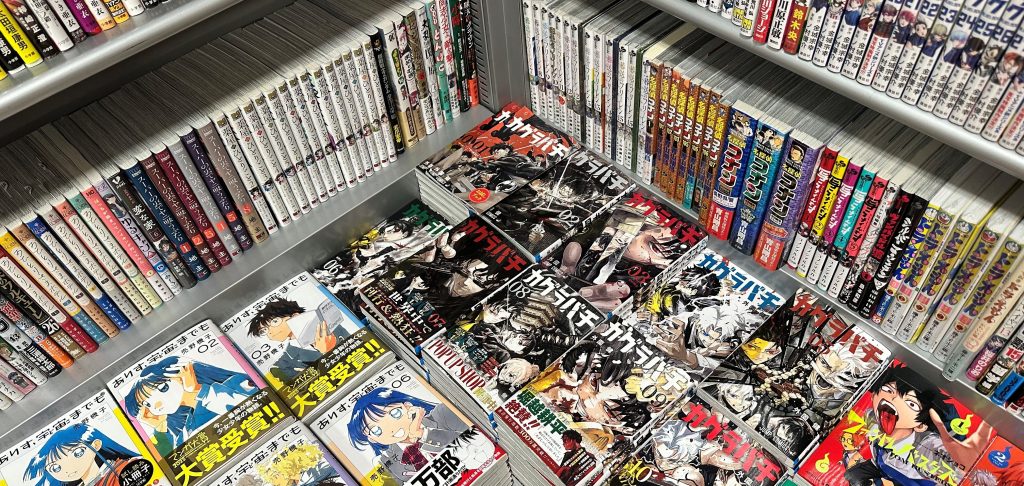
Take a ride on a Tokyo subway and you notice that people are glued to their phones. What are they doing? Some play games. Some watch movies. And many are immersed in manga, Japanese comics.
I expected teens to be the main fans. Instead, I saw businessmen in suits, older women, and commuters of all kinds enjoying manga.
Unlike in Western countries, where comics are often seen as children’s entertainment, manga in Japan is for all ages: kids, teenagers, office workers, parents, and seniors.
And for each group there are specific genres. You can read manga about business, history, cooking, and romance – even golf or politics.
Reading manga doesn’t feel childish, it’s woven into society.
There are even manga cafés (manga kissa). You pay by the hour and choose from thousands of volumes while you’re there. Many are open 24 hours and cater to commuters who missed the last train. Staying at a manga kissa is cheaper than paying for a cab.
Manga is not new to Japan and has deep historical roots. As early as the 12th century, traditional emaki scrolls told stories in pictures, ranging from folk tales to disaster reports and moral lessons.
In museums, I saw historical emaki showing battlefield reports and how to behave in society. I smiled at one that showed what happens when you are greedy: you are reborn as a miserable ghost.
After World War II, artists like Osamu Tezuka modernized manga and made it mainstream. If you are into manga, you may know his iconic Astro Boy character, a humanoid robot widely regarded as the foundation for modern anime and manga.
Today, manga are beloved because they perfectly fit into everyday life: during long commutes, short breaks, or at home – covering topics like personal growth, hard work, perseverance and friendship. They are portable, affordable and quick to read.
Many are serialized with new editions every week.
It’s also a huge industry driving anime (the animated versions of manga), games and merchandise. It’s not just entertainment — it’s a cultural and economic engine.
Manga in Japan is not a niche – it’s mainstream storytelling like novels or television in other countries.
Did you know?
- Manga is read from right to left – even the English versions. What looks like the back cover is actually the front of a manga.
- Most manga is printed in black and white to keep costs low and release weekly.
- Manga is one of the most profitable sectors in Japanese publishing, accounting for roughly one-third of the market.
Read more Japan Nuggets: https://japannuggets.com/


Leave a comment