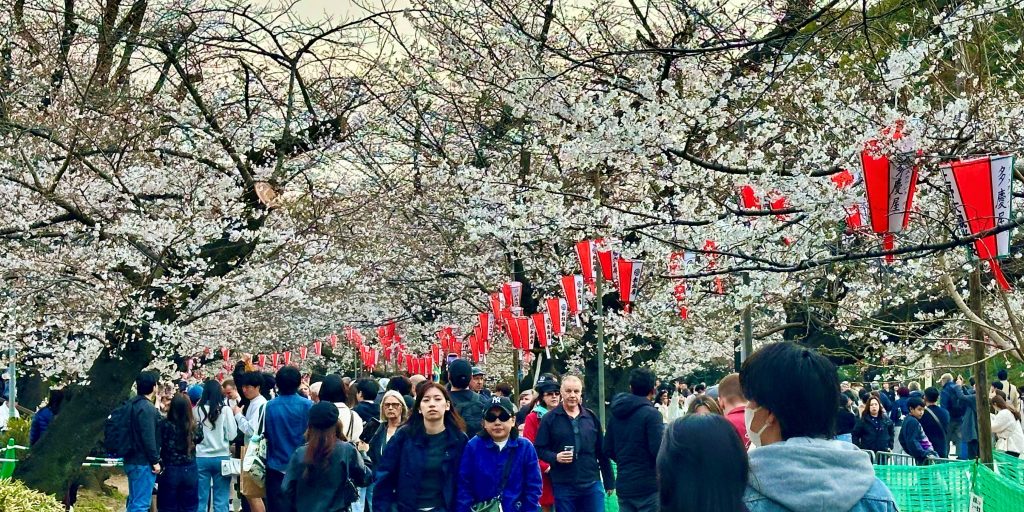
Everyone talks about it. It’s everywhere you go.
It’s the quintessential spring moment, with festivals and pop ups across Japan.
When offices, families, and groups of friends gather in parks, you know it’s official. Sakura, the cherry blossom season, has arrived.
And with it comes hanami: the art of sitting under blooming cherry blossoms and collectively agreeing that yes, this is beautiful! People with very big and very small cameras at seemingly every tree, trying to capture the perfect bloom.
Is it a bit of hype? Yes. But it’s also tied to a mix of history, philosophy, and social tradition that runs deep in Japanese society.
For Japanese people, cherry blossoms symbolize the beauty of the moment. It connects to the Japanese idea of mono no aware, the awareness that things are fleeting.
And that’s exactly what makes them beautiful. Cherry blossoms only last for 1-2 weeks, and they can disappear even faster if there’s rain or wind.
So, sakura is a reminder that life is short and moments don’t last. Appreciate things while they’re here. It’s both deeply philosophical and very social at the same time.
And there’s a lot of history. Sakura has been celebrated for over 1,000 years. Aristocrats once wrote poetry under the trees. Even samurai, known for their discipline and strength, admired their fragile beauty.
Sakura also represents a new beginning. The trees bloom in late March or early April, right when the new school and business year starts in Japan. It feels almost like a nationwide reset. A shared fresh start.
In a way, it has become a symbol of Japan – just like maple leaves in Canada and tulips in Amsterdam.
But why cherry blossoms, I wondered? Why not plum or wisteria blossoms which are just as beautiful? The answer is timing. Plum arrives too early, wisteria a little too late. Sakura bloom exactly when spring begins. They don’t just mark the season – they turn it.
In Tokyo, it can feel like the entire city is blooming at once, creating a dramatic, unifying moment.
Did you know:
- TV networks track the “cherry blossom front” as it moves north across Japan, building anticipation for the perfect viewing moment.
- Many brands release seasonal sakura products – from sweets like mochi and puddings to teas, lattes, sodas, mugs, tote bags and even sakura-scented perfume.
- Sakura season is one of Japan’s biggest tourist draws and a peak travel period. Some popular photo hot spots can get more than 10,000 visitors per day.


Leave a comment