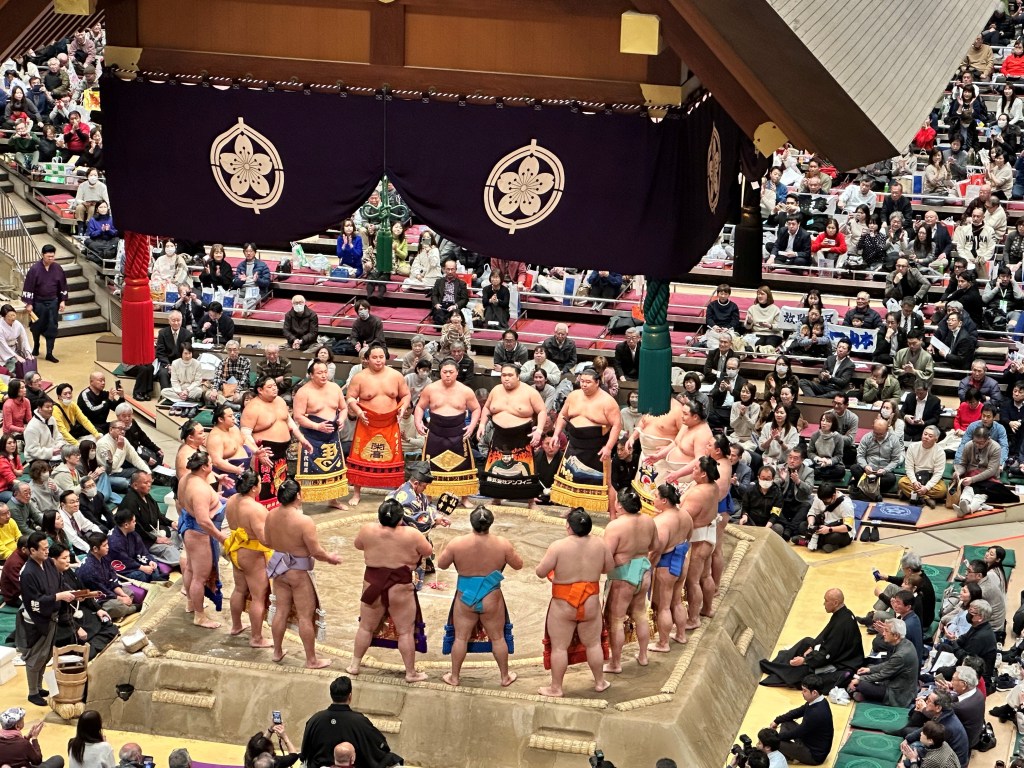
What do you picture when you think of sumo? Big guys pushing each other out of a ring? You’re not wrong – but you’re also missing about 90% of the story.
For most Japanese people, sumo isn’t just a sport. It’s a category of its own: a highly ritualized competition with deep religious roots.
Yes, there are rules, rankings, tournaments, referees, and professionals competing for titles – just like any sport.
But unlike most sports, sumo is rooted in the Shinto religion and began centuries ago at shrines. It was a way to thank the gods.
That’s why wrestlers show up almost naked: it’s a display of honesty. Nothing hidden.
The ring (dohyō) is sacred, and before every match wrestlers throw salt, rinse their mouths, and cleanse their bodies—part spiritual ceremony, part pre-fight routine.
What’s amazing is how little this has changed over time. The clothes of wrestlers and referees look almost exactly as they did in the 17th century.
Even the “tiny pants” (mawashi) follow ancient rules: a single long strip of heavy silk, about 9 meters (30 ft) long wrapped around the body several times and secured with knots in the back. Don’t let it drop!
The Japanese Sumo Association doesn’t even call sumo a modern sport—it calls it kokugi, Japan’s national discipline or art. That’s why there are no replays, sensors, or VAR debates. The goal is continuity, not modernization.
And yes, most sumo wrestlers are big—but they’re also incredibly athletic. Under all that body fat is serious muscle.
Fights usually last just a few seconds (after up to four minutes of ritual buildup). Winning is less about size and more about timing, footwork, and reading the opponent.
I’ve seen smaller wrestlers take down much bigger ones. It’s all about the technique.
I was amazed at how passionate and loud Japanese fans can get at tournaments — a side of Japan I hadn’t seen before.
To bring it home you could think of soccer as a sport with traditions while sumo is a tradition that happens to look like a sport.
Did you know?
- Many of today’s top sumo wrestlers are from Mongolia. The current top champion is Ukrainian (Aonishiki Arata), who won the January 2026 New Year Grand Tournament in Tokyo (I saw him there, and he was truly impressive!)
- Women aren’t allowed in the dohyō—not even doctors or the Prime Minister. When Japan appointed its first female Prime Minister, she was barred from entering the ring to present the Prime Minister’s Cup. Yet women do practice sumo and compete at the amateur level—and interest is growing.
- Referees’ kimonos cost around US$6,000–10,000. Add gemstones and the price goes up. Quite a luxury tradition!


Leave a comment